Wednesday, July 10, 2013

Making a Big Step in Photos... Maybe

So, like any good amateur photographer, I've started figuring out the types of photographs that I enjoy taking, the equipment necessary to take those photos (in the style/manner I choose), and the fact that I have not become independently wealthy overnight. I love my D3100. I've taken it a lot of places, beaten it up a bit, but it's never complained or failed. In fact, it's almost encouraged me to take photos in places that I might not have. I took this thing into the Rockies for skiing, padding it with sweatshirts, and, when I look at those photos, I can't regret that decision at all. I even took some pretty good sized falls, and the camera came back with nary a scratch (I wasn't quite that unscathed).

But, as you can probably see with my last two posts, I'm starting to enjoy nature photography and sports photography. I'm not deluded. I won't be setting up blinds for 12 hour days with an 800mm lens. I don't have the money, time, or the desire to do that! I'm not going to have a set of super fast 300mm and 400mm lenses for sports. But I am going to try and take better and more interesting photos of these things. And, when cropping down my photos from the two baseball games and my time in the park, I realized - I either needed better lenses, or a camera that could handle an ISO above 200.

So, off I went to my local camera shop, hoping to just shoot some test shots - the D3100 with a nice fancy lens, and a D7100 with my 55-200mm f/4-5.6. No go. They suggested doing online rental for that. But, I did check one fact on the D7100 - did it have an internal focus motor? The answer? Yes.


For a limited budget amateur photographer, that was music to my ears. Search on 70-200mm f/2.8 lenses made by Nikon. No focus motor in the lens? There's a $1,400 savings. Older lenses just became nearly as good as their modern versions. That was it. I had to make the plunge.

So, I ordered up a D7100. I felt terribly not going back to the local camera chain store - but they couldn't offer the extra memory card and battery that an online retailer did. The extra battery was the deal breaker. Online it was. Hey, if I do get a higher end lens, it'll definitely be at the store (and probably a filter or two). That's my justification.


I had been toying around with this idea for several months, but I really hadn't outgrown the D3100 in any obvious manner. Three weeks of shooting and enjoying that shooting opened my eyes. Will I toss my D3100? Heck no. It's still amazing for 60-70% of the shots I'll take, in all likelihood. Slap that 35mm f/1.8, and it will do amazing things. But at distance where cropping has to happen/ The D7100 was the logical step.

I know - the gear doesn't make the photographer. And I'm still going to work on basic exercises around town. But I also want to explore what I'm capable of capturing, and I don't want to limit myself. So, the next couple of posts will be my first impressions as an "advanced beginner" photographer using a true pro-sumer body. I'll give you a hint - I love this thing.


Sunday, July 7, 2013

Sitting Still, Enjoying the Day, and Shooting

One of the great things about living in a city is that, in the parks and other quieter places where there is more nature than people, the wildlife is willing to be a bit more adventurous. Birds - not just pigeons and sparrows - hop right by you, going about their business, not too concerned with the upright ape-thing. This is an amazing thing for photographers, especially those that don't have the hyper-long focal length lenses that most bird photographers need.

Even still, at 200mm and wide open, my D3100 needs to go up a bit on the ISO to be fast enough in the shade. And, of course, I need to play with cropping in Lightroom. It may feel a bit like cheating to recompose after the image is taken, but wildlife isn't always cooperative in getting the best angle or composition in real time! Now, if I were doing street photography and cropped this much, I'd feel like a lazy photographer. But when my lens can't quite reach out, I'll sit back and crop!

So, I spent the day in Rock Creek Park, reading, enjoying the beautiful weather, and being on the look out for interesting shots. In my next post, I'll explain just how educational this whole experience was for me, but, for now, enjoy the images!

Equipment Used

Nikon D3100 Camera
55-200mm f/4-5.6 lens

Images


Shooting Baseball in Natural Light

Growing up, I've always loved baseball. In the D.C. area, there are several teams to go see, and it's quite easy to get close to the action (especially at the minor league parks). What better way to enjoy a game and get some good images?

Since I don't own anything impressive like a 400mm lens, I rely mostly on cropping images down from a 200mm size to try and get the image I was looking for. Nothing too difficult, but it began to show me the limitations of my camera. Without further ado, I've posted some shots taken at a Bowie Baysox game, and at a Washington Nationals game (Stub Hub is amazing for cheap tickets - even close to the action).


Equipment Used

Nikon D3100 Camera
55-200mm f/4-5.6 lens


Images


Wednesday, May 8, 2013

What Does a Speedlight Do? A Comprehensive Look


Like a lot of amateurs, I find flashes and lighting intimidating. I hate how on-camera integrated flashes look in the end, so I try and use only available light. I do know, however, that amazing colors and action can be captured with a flash. And I know that I'm missing out.

Fortunately, a friend of mine has a Nikon SB-700 Speedlight, and was happy to let me try it out! Now, I read all about flashes, and power settings, and other interesting things. But, the one thing that I couldn't find were examples of those settings. We only post the good shots, right? So, here it is. The quick and dirty guide to speedlight results!

Camera settings were identical for each picture, and the subject was the same distance: 1/200, f/1.8, approximately 6 feet away. I will present three photos at each setting. One with a wide illumination pattern, one at standard, and one taken with the built-in wide panel diffuser. This is pretty image heavy, but I think it's an interesting look in detail at lighting for the novice.

What I found most interesting about the below images was that shooting on full power doesn't just drain your batteries - in a standard indoor environment with not much in the way of ambient light, this will overexpose your shot when doing a direct ceiling bounce. Only the full power, 90 degree bounce with wide illumination looks halfway decent in terms of color and shadow. But as the other shots show, you can just dial down the power and get the same shot while having a shorter recycle time!

Wide illumination consistently gave the best light, and seemed to kill the hard shadows on the underside of my table. That same shadow only started to disappear at 75 degrees with standard illumination, and never went away with the built-in diffuser.

So where is the happy place? The answer is the worst one out there! It depends! What kinds of colors are you going for? What kinds of shadows do you want present in the picture, or removed? What is your environment like? The beautiful thing with digital photography is that you can experiment and get a feel for what you like very cheaply. This project would have been two rolls of film, plus development costs, all for pictures that, in the long run, are solely for learning. The freedom that digital allows is perfect for learning lighting!

Equipment Used


Nikon D3100 Camera
35mm f/1.8 lens
SB-700 Speedlight (borrowed)
The Thinker

Images


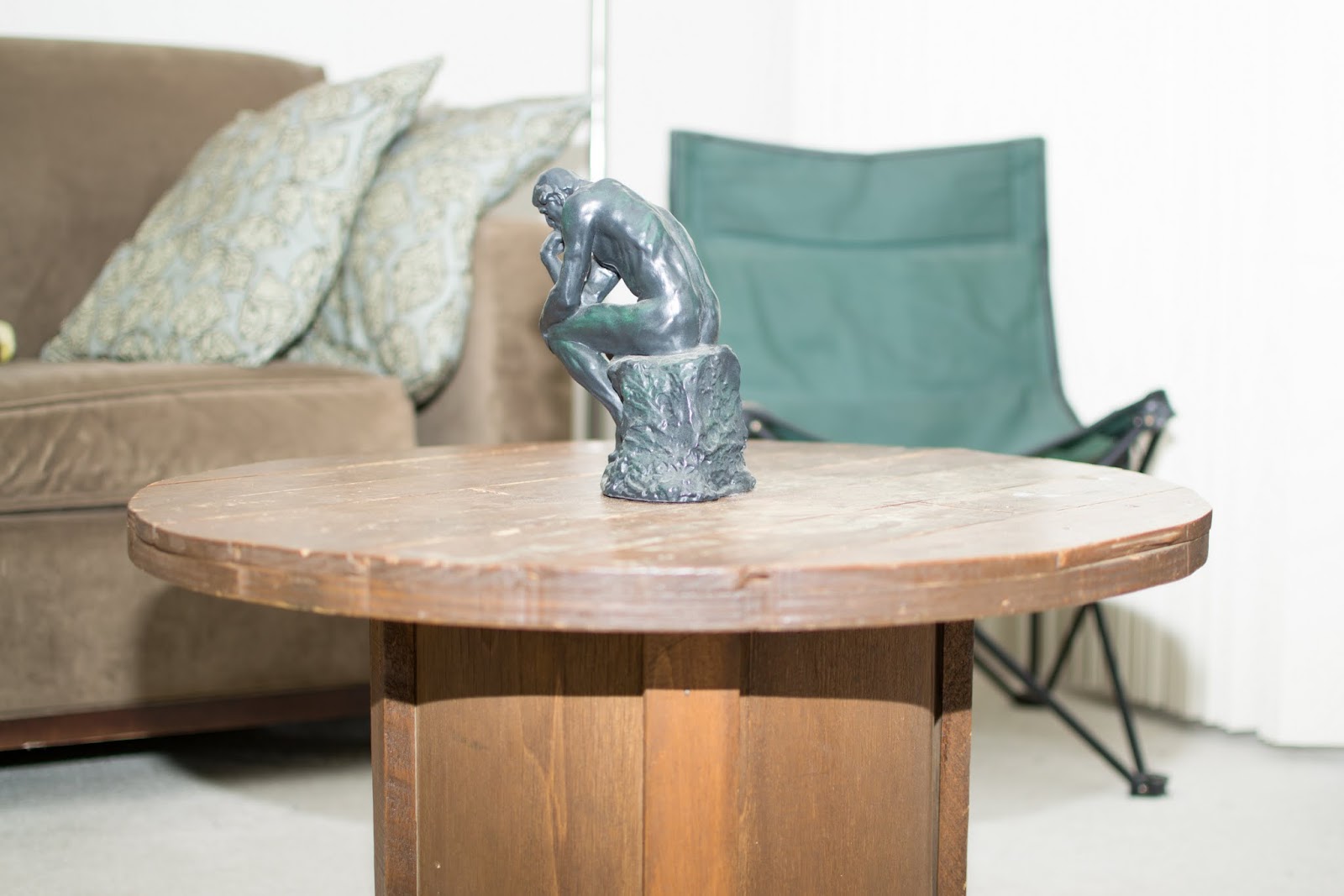
I couldn't help myself. Here's the scene with available light


The top two images in each set will have the wide illumination on the left and standard on the right. The third picture will be with the diffuser.

Flash Angle: Zero Degrees
Power: 1/1


Flash Angle: Zero Degrees
Power: 1/2


Flash Angle: Zero Degrees
Power: 1/4


Flash Angle: Forty-Five Degrees
Power: 1/1


Flash Angle: Forty-Five Degrees
Power: 1/2


Flash Angle: Forty-Five Degrees
Power: 1/4


Flash Angle: Sixty Degrees
Power: 1/1


Flash Angle: Sixty Degrees
Power: 1/2


Flash Angle: Sixty Degrees
Power: 1/4


Flash Angle: Seventy-Five Degrees
Power: 1/1


Flash Angle: Seventy-Five Degrees
Power: 1/2


Flash Angle: Seventy-Five Degrees
Power: 1/4


Flash Angle: Ninety Degrees
Power: 1/1


Flash Angle: Ninety Degrees
Power: 1/2


Flash Angle: Ninety Degrees
Power: 1/4